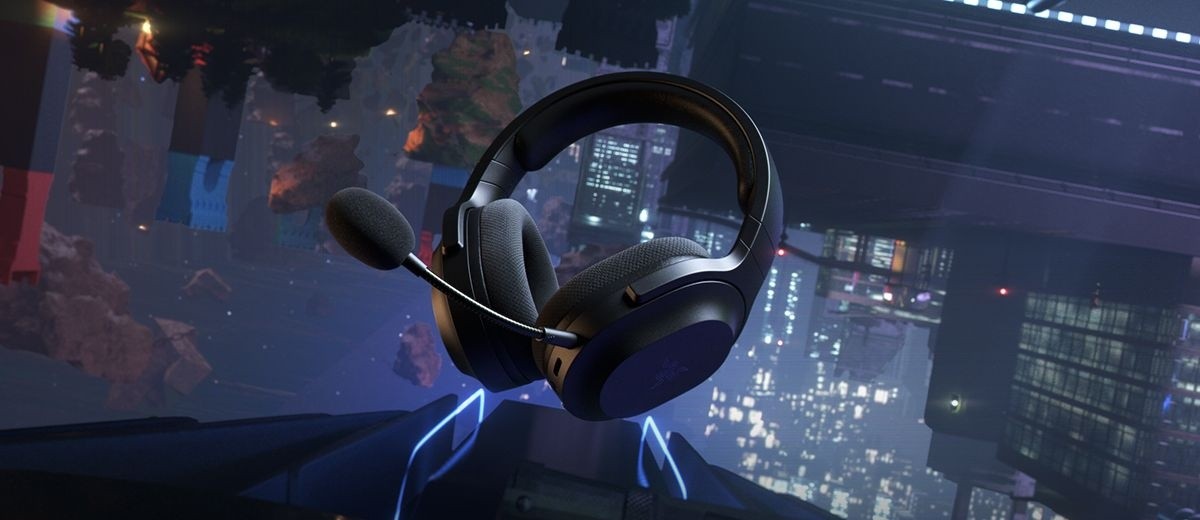
Razer Razer Kraken V4
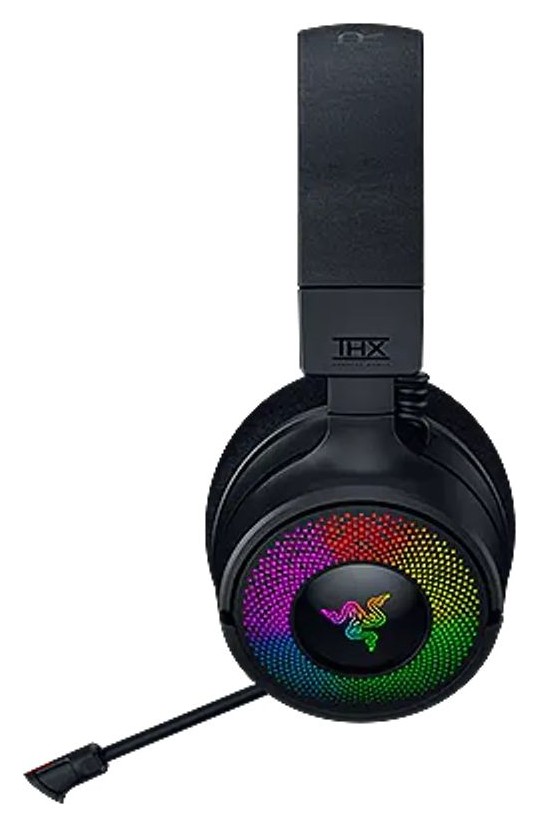
A wireless Kraken with three connection modes, TriForce Titanium 40 mm drivers, THX Spatial Audio, a retractable super wideband mic and up to 70 hours of battery with the lighting off.
Specifications
| Drivers | Razer TriForce Titanium 40 mm |
|---|---|
| Microphone | Retractable HyperClear Super Wideband |
| Surround | THX Spatial Audio |
| Connectivity | HyperSpeed Wireless 2.4 GHz (USB Type-C dongle), Bluetooth 5.3, USB wired (Type-C to Type-A cable) |
| Battery | Up to 70 h (lighting off, 2.4 GHz); up to 35 h (lighting on) |
| Charging | About 4 h full charge; 15 min for about 6 h of play |
| Lighting | 9-zone Razer Chroma RGB, 16.8 million colors |
| Weight | 350 g |
| Latency (2.4 GHz) | 20 ms per Razer FAQ |
| Software | Razer Synapse (EQ presets: Game, Movie, Music, Custom) |
| Warranty | Up to 2 years |
| Starting Price | US$179.99 |
The Razer Kraken V4 is the middle model in a three-headset family, and, as Razer puts it, the Kraken is now wireless. Razer sells it from 179.99 US dollars and describes it as a wireless gaming headset with three ways to connect, a super wideband microphone that tucks into the earcup, and nine-zone Chroma lighting. This guide is built from Razer's product page, its comparison table and its FAQ. We have not worn this headset ourselves, so where the page is marketing we say so, and where a number could be read two ways we explain which reading we used.
Where the V4 sits in the family
Razer's page puts three headsets side by side: the Kraken V4 Pro, the Kraken V4 and the Kraken V4 X. The differences are easier to see in a list than in a paragraph.
- Drivers: Bio-Cellulose 40 mm on the Pro, TriForce Titanium 40 mm on the V4, plain TriForce 40 mm on the X.
- Microphone: a retractable HyperClear Super Wideband mic on the Pro and the V4, a retractable HyperClear Cardioid mic on the X.
- Surround: THX Spatial Audio on the Pro and the V4, 7.1 surround sound on the X.
- Connection: the Pro and the V4 have 2.4 GHz wireless and Bluetooth 5.3; the Pro adds simultaneous audio and a 3.5 mm port on its OLED control hub; the X is wired only, over USB Type-C or, with the included adapter, Type-A.
- Weight: 397 g for the Pro (not counting the control hub), 350 g for the V4 and 310 g for the X.
One caution about reading the table: it is a three-column grid flattened into text, so we assigned each cell to a column by counting values, and the result matches the page's own benefit list, which quotes the 70-hour battery figure next to the V4. If you are choosing between the three, open Razer's table and confirm the column before you buy.
Three ways to connect
The V4 works over Razer HyperSpeed Wireless on 2.4 GHz using a small USB Type-C dongle, over Bluetooth, and over a USB cable. The cable is a USB Type-C to Type-A lead that Razer says acts as both charging and audio cable, and the headset stays fully functional while it is plugged in. The page's FAQ is direct about which wireless mode to use at a PC: 2.4 GHz is the one for gaming, with a stated latency of 20 ms and a more stable link, while Bluetooth is for mobile use without the dongle.
The Bluetooth side has a useful detail. The FAQ says Razer SmartSwitch Dual Wireless lets you pick up an incoming call from a paired phone even while the headset is connected over 2.4 GHz. For someone who plays or works at a desk with a phone next to the keyboard, that is more practical than it sounds. Note that the simultaneous-audio feature is listed for the Pro only, so the V4 is about call pickup rather than mixing two audio streams at once. If your setup mixes a desk PC with calls, our headset buying guide for wired, wireless, calls and gaming explains how to weigh the connection modes.
Sound: drivers, THX and profiles
Razer calls the drivers TriForce Titanium 40 mm and says the patented three-part design keeps highs, mids and lows from muddying. That is a manufacturer claim, and the page gives no frequency response, impedance or sensitivity figures, so there is nothing numerical to compare with other headsets. What the page does provide is a set of software features. THX Spatial Audio is included automatically and is integrated into Razer Synapse. There are THX game profiles for more than 60 supported titles, with Apex Legends and Call of Duty named as examples, and four equalizer presets: Game, Movie, Music and Custom. Razer recommends Game for competitive shooters, Movie for MOBAs, RPGs and films, and Music for music, and all of them can be adjusted in Synapse. If you want to understand what spatial audio and drivers really do, our explainer on headset drivers and soundstage is a good companion read.
Game and chat balance is handled either through the earcup controls or through Synapse, and you can switch the control between overall volume and the game-to-chat mix. That is worth having if you play with a team on voice chat, because you can pull the voices up without touching the game.
The microphone
The V4 carries a retractable HyperClear Super Wideband microphone. Razer says the technology derives from the mic in its BlackShark V2 Pro, and that it covers a wider frequency range so voices sound clearer and more natural. We list the BlackShark V2 Pro in our catalogue, so you can compare the two on their BlackShark V2 Pro page. The design is flush: you pull the mic out of the earcup, bend the flexible gooseneck into place, and push it back in when you are done. No frequency response or sensitivity is stated for the mic, so treat clarity claims as Razer's own.
Comfort and build
The page lists three comfort features: a swivel mechanism for added comfort and better sealing, breathable fabric with memory foam cushions to stay cool through long sessions, and a compact USB Type-C wireless dongle. At 350 g the V4 sits between the Pro and the X in weight. Razer does not give clamping force, ear-cup dimensions or head size limits, so we cannot say how it will fit a large head or glasses; if that matters, try one in a shop or use a retailer with easy returns. Razer's own store advertises 14 days of risk-free returns and up to two years of warranty.
Battery and charging
The headline is up to 70 hours with lighting off on 2.4 GHz, or up to 35 hours with lighting on. Charging is quick by the page's account: about 4 hours for a full charge, and 15 minutes for roughly 6 hours of play. Those are lab-style figures, and the lighting is the big variable. Nine individually programmable earcup zones, 16.8 million colours and effects that work with more than 300 games and 500 devices through Chroma are attractive, but if you care about the battery figure, plan on keeping the lighting off or dim most of the time.
Who it suits
This is a good fit if you want one headset that moves between a PC, a console and a phone without much fuss, if you use voice chat and want a retractable mic, and if you like software control of EQ and lighting. It is a less obvious choice if you want the lightest possible headset (the X is 40 g lighter but wired only), or if you want the premium extras of the Pro such as the OLED control hub and the Bio-Cellulose drivers. If your priority is call quality for work rather than play, compare it with a business headset such as the Corsair HS80 Max Wireless, or read our Arctis Nova Pro Wireless review to see what a base-station headset offers instead.
What to check before you buy
- Confirm the column of the comparison table so you know you are reading the V4, not the Pro or the X.
- Decide whether you need the 3.5 mm port and simultaneous audio, which are Pro-only.
- Remember that the 70-hour figure assumes lighting off and the 2.4 GHz connection.
- Check that your console accepts the USB dongle; the page does not list console compatibility per model, so read the current listing.
- Look at the full range of alternatives on our headsets page if you want to compare weight and battery at a glance.
In short, the Kraken V4 is a well-equipped mid-family wireless headset with a genuinely useful three-mode connection, a battery that lasts if you tame the lighting, and software features aimed squarely at gamers. Keep in mind the honest limits: Razer's page tells us little about measured sound, mic performance or fit, so this is a headset to buy with a return window in mind.